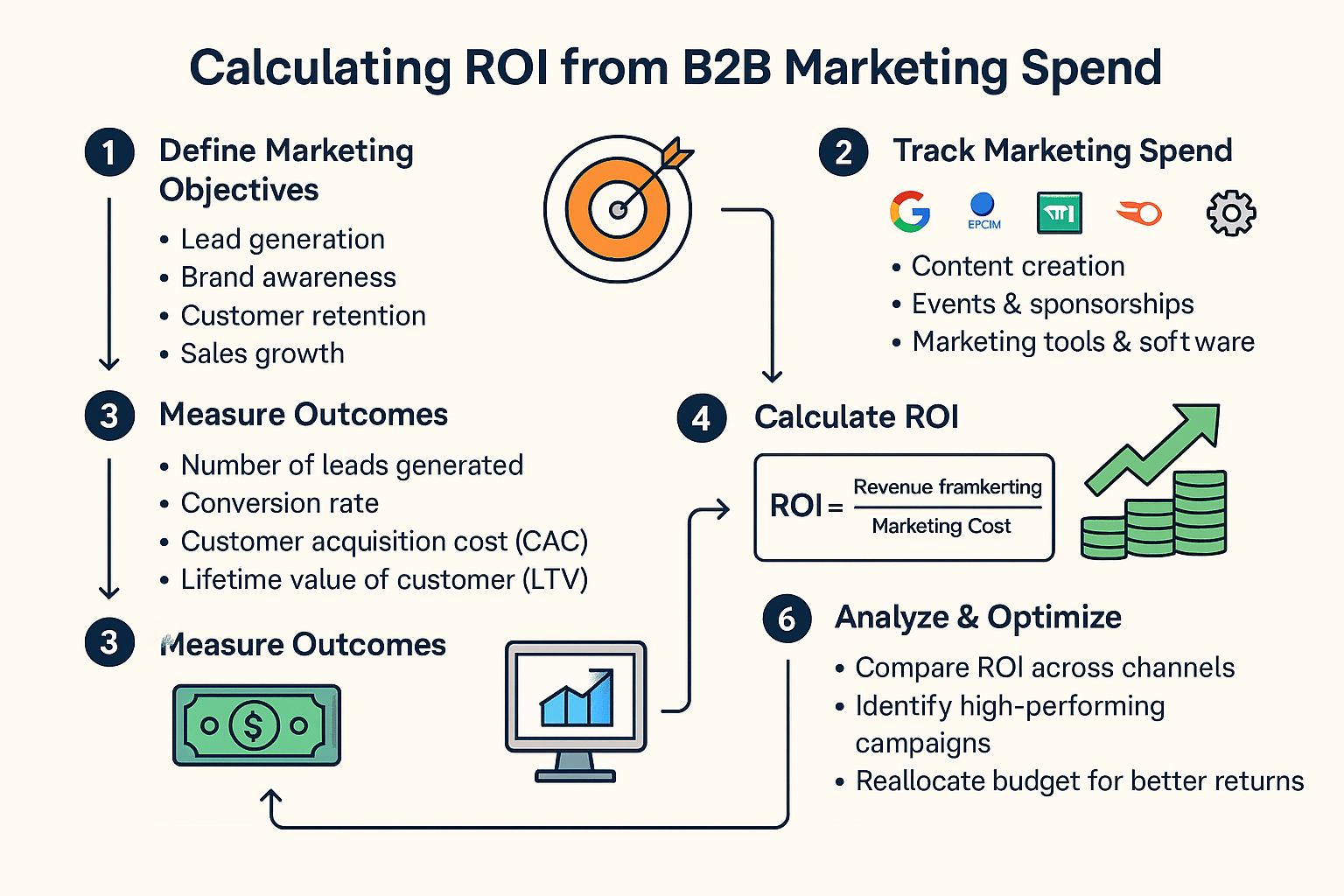
Calculating ROI from your marketing budget
In the world of B2B marketing, every pound spent needs to justify its existence. Unlike B2C, where emotional appeal and impulse buying often drive results, B2B decisions are rational, long-term, and involve multiple stakeholders. That’s why calculating Return on Investment (ROI) from marketing spend isn’t just a nice-to-have—it’s essential.
What Is Marketing ROI?
Marketing ROI measures the revenue generated from marketing activities relative to the cost of those activities. It helps businesses understand which campaigns are driving growth and which are draining resources.
Basic formula:
Marketing ROI=Revenue Attributed to Marketing−Marketing CostsMarketing Costs×100\text{Marketing ROI} = \frac{\text{Revenue Attributed to Marketing} – \text{Marketing Costs}}{\text{Marketing Costs}} \times 100
But in B2B, it’s rarely that simple.
Why B2B ROI Is More Complex
- Longer sales cycles: Deals can take months or even years to close.
- Multiple touchpoints: Prospects engage with various content and channels before converting.
- Attribution challenges: Which touchpoint gets credit for the sale?
To tackle this, B2B marketers need a more nuanced approach.
Step-by-Step Guide to Calculating B2B Marketing ROI
- Define Your Goals
Are you measuring ROI for lead generation, brand awareness, or customer retention? Each goal requires different metrics.
- Track Marketing Costs
Include:
- Ad spend
- Content creation
- Software/tools
- Agency fees
- Staff salaries (if applicable)
Be thorough—hidden costs can skew your ROI.
- Set Up Attribution Models
Choose how you’ll assign credit to marketing efforts:
- First-touch: Credit goes to the first interaction.
- Last-touch: Credit goes to the final interaction before conversion.
- Multi-touch: Distributes credit across all touchpoints.
Multi-touch attribution is ideal for B2B but requires robust analytics.
- Measure Revenue Impact
Use CRM and marketing automation tools to link leads and deals back to specific campaigns. Key metrics include:
- Number of qualified leads
- Conversion rate
- Average deal size
- Customer lifetime value (CLV)
- Calculate ROI
Apply the formula using the revenue attributed to marketing efforts. For example:
- Marketing spend: £50,000
- Revenue from marketing-generated leads: £200,000
ROI=£200,000−£50,000£50,000×100=300%\text{ROI} = \frac{£200,000 – £50,000}{£50,000} \times 100 = 300\%
Tools That Help
- HubSpot: CRM and marketing automation with ROI tracking
- Google Analytics: Tracks web traffic and conversions
- Salesforce: Links marketing campaigns to closed deals
- Tableau or Power BI: Visualise ROI across channels
Optimising for Better ROI
Once you’ve calculated ROI, use the insights to:
- Double down on high-performing channels
- Refine underperforming campaigns
- Align sales and marketing teams
- Improve lead nurturing workflows
Final Thoughts
ROI isn’t just a number—it’s a compass. In B2B marketing, where budgets are scrutinised and results take time, understanding ROI empowers marketers to make smarter decisions, prove value, and drive sustainable growth